



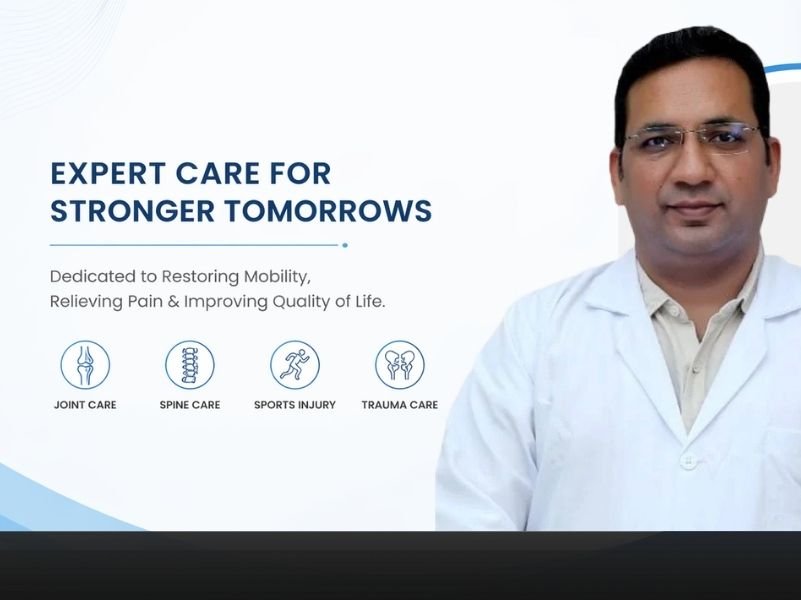
Dr. Rakesh Sharma
When a patient walks into Dr. Rakesh Sharma’s consultation room at Pushpanjali Hospital, Paschim Vihar, they usually come carrying more than just pain, they carry months of confusion, failed treatments, and unanswered questions. Dr. Rakesh Sharma’s first job, before any X-ray or prescription, is to listen.
That habit of listening carefully, not rushing to conclusions, is what has kept patients coming back to him for over 23+ years. Born and trained in medicine with a clinical focus on bones, joints, and the musculoskeletal system, Dr. Rakesh Sharma has built his reputation one correct diagnosis at a time.
He holds an MBBS degree, a DNB in Orthopedics from the National Board of Examinations, New Delhi, and a Diploma in Orthopaedics. These are not just credentials on a wall, they represent a surgeon who completed his training through one of the most rigorous medical examination systems in India and chose to dedicate his entire career to orthopedic care.
Dr. Rakesh Sharma consults at Pushpanjali Hospital, RR-30, Block B, Mianwali Nagar, Paschim Vihar, New Delhi, Delhi, 110087. The hospital supports his practice with digital X-ray, MRI imaging, a fully equipped operating theatre, and a dedicated physiotherapy and rehabilitation wing, everything under one roof so patients do not have to run between facilities.
What Dr. Rakesh Sharma Actually Treats
Orthopedics is a wide field. Some surgeons focus only on trauma, others only on joints. Dr. Rakesh Sharma works across the full musculoskeletal spectrum, from a school-going child with a growth-related bone issue to a 70-year-old whose knee has finally given out after decades of wear.
His areas of clinical focus include:
Joint Replacement Surgery: Knee replacement and hip replacement are among the most life-changing surgeries in orthopedics, and also among the most feared. We explains the procedure in plain language before recommending it, and he only recommends surgery when conservative treatment has genuinely stopped working. He performs both conventional and robotic-assisted joint replacement procedures at Pushpanjali Hospital.
Arthroscopic Surgery: Arthroscopy is a minimally invasive procedure used to diagnose and treat problems inside a joint, most commonly the knee and shoulder. Because it involves a small camera and instruments rather than a large incision, patients recover faster and experience less post-operative pain. We uses arthroscopy for conditions like ACL tears, meniscus injuries, and rotator cuff problems.
Fracture & Trauma Management: Fractures need to be assessed quickly and treated correctly the first time. We handles both simple fractures and complex trauma cases, including intra-articular fractures and cases involving significant soft-tissue involvement. The goal is always anatomical alignment and functional restoration.
Sports Injury Treatment: Athletes, whether professional or recreational, put specific stresses on their ligaments, tendons, and cartilage. We understand that for a sportsperson, the question is not just “will I recover?” but “will I get back to full performance?” His sports injury management combines accurate imaging, appropriate intervention, and a structured rehabilitation protocol.
Knee Pain & Osteoarthritis: Osteoarthritis of the knee is one of the most common orthopedic presentations in urban India, particularly among patients above 45. We follows a staged approach, starting with physiotherapy, intra-articular injections, and lifestyle modification before moving toward surgical options. Many of his patients avoid surgery altogether through this structured conservative management.
Shoulder & Neck Pain: Cervical spondylosis, rotator cuff tears, frozen shoulder, and impingement syndromes are frequently misdiagnosed or undertreated. We evaluates each case with imaging support and treats the root cause rather than just managing the symptom.
Spine-Related Conditions: While Dr. Rakesh Sharma’s primary focus is peripheral joints, he also evaluates and manages common spine conditions including disc prolapse, sciatica, and lumbar spondylosis, particularly where these conditions affect a patient’s overall musculoskeletal function.
Pediatric Orthopedic Conditions: Children’s bones grow, and sometimes they grow incorrectly. We sees pediatric patients for conditions like developmental dysplasia, limb deformities, and growth-plate injuries, conditions that require different thinking from adult orthopedics.
Ligament & Muscle Injuries: Partial and complete ligament tears, muscle strains, and tendon injuries are common across all age groups. We assess the degree of injury and determine whether conservative management or surgical reconstruction is the appropriate path.
How Dr. Rakesh Sharma Approaches a Consultation
A lot of orthopedic mismanagement happens because of rushed consultations. A patient describes pain, an X-ray is ordered, and a prescription is written, sometimes without fully understanding how that pain started, what makes it worse, or how it affects the patient’s daily life.
Dr. Rakesh Sharma’s consultation process is deliberately structured to avoid that.
Step 1 — Symptom History The consultation begins with a detailed conversation. When did the pain start? What were you doing? Has it changed over time? Do you have any prior injuries, surgeries, or systemic conditions like diabetes or thyroid issues that could affect bone and joint health? These details matter, and we take the time to collect them.
Step 2 — Physical Examination After the history, Dr. Sharma performs a systematic musculoskeletal examination, assessing range of motion, joint stability, muscle strength, gait, and specific clinical tests relevant to the suspected diagnosis. This step cannot be replaced by imaging alone.
Step 3 — Diagnostic Imaging Where needed, Dr. Sharma requests targeted imaging, digital X-rays for bone structure and alignment, MRI for soft tissue detail, or ultrasound for dynamic assessment of tendons and bursae. At Pushpanjali Hospital, this imaging is available on-site, which means no delays between diagnosis and discussion.
Step 4 — Explanation in Plain Language Once Dr. Sharma has a diagnosis, he explains it clearly, what is happening in the joint or bone, why it is happening, what the treatment options are, and what happens if treatment is delayed. He does not use jargon to impress; he uses plain language to inform. A patient who understands their condition makes better decisions about their treatment.
Step 5 — Individualised Treatment Planning No two patients receive the same treatment plan. A 55-year-old teacher with moderate knee osteoarthritis needs a different management strategy than a 28-year-old athlete with an ACL tear. Dr. Rakesh Sharma builds each plan around the patient’s specific condition, age, activity level, and goals.
Conservative Treatment Before Surgery — Always
Dr. Rakesh Sharma does not recommend surgery as a first response. This is an important point for patients who come in nervous about what they might be told.
Wherever clinically appropriate, he begins with non-surgical management, structured physiotherapy, targeted exercises, anti-inflammatory medication, and interventional procedures like PRP (Platelet-Rich Plasma) injections or corticosteroid injections into the affected joint. Many patients see significant improvement through this route and never require surgery.
Surgery is recommended only when:
- Conservative treatment has been properly attempted and has failed to deliver adequate relief
- The structural damage to a joint or bone is severe enough that non-surgical treatment cannot address it
- Delayed surgery would result in greater long-term damage or disability
This philosophy, conservative first, surgical when necessary, is what distinguishes a genuinely patient-focused orthopedic surgeon from one who defaults to the operating table.
Rehabilitation: Where Recovery Actually Happens
Surgery, when it is needed, is only the beginning. The real recovery happens in physiotherapy, and Dr. Sharma gives post-operative rehabilitation the same attention he gives the procedure itself.
After joint replacement or arthroscopic surgery, patients follow a structured rehabilitation protocol at Pushpanjali Hospital’s physiotherapy unit. This includes early mobilisation to prevent joint stiffness, progressive strengthening of the muscles around the operated joint, gait retraining where needed, and return-to-activity planning based on the patient’s specific goals.
Dr. Sharma monitors his patients through this recovery phase. Post-operative follow-ups are not a formality, they are an active part of the treatment.
Why Patients from Across Delhi Come to Paschim Vihar
Paschim Vihar and the surrounding areas of West Delhi, Janakpuri, Rajouri Garden, Punjabi Bagh, Tilak Nagar, Peeragarhi, and Nangloi, have a large and underserved demand for quality orthopedic care. Patients in this belt often have to travel to central Delhi or Gurgaon for specialist consultations.
Dr. Rakesh Sharma’s practice at Pushpanjali Hospital fills that gap. Over the course of more than two decades, he has treated patients not just from Paschim Vihar but from across West Delhi and beyond, people who discovered through word of mouth or through their own research that consistent, honest orthopedic care was available close to home.
The location itself is easy to find, opposite Metro Pillar No. 310 on Rohtak Road, Peeragarhi, and the hospital infrastructure backs up every consultation with the diagnostic and surgical support needed to deliver complete care.
Conditions Dr. Rakesh Sharma Treats — At a Glance
- Knee osteoarthritis and knee replacement
- Hip osteoarthritis and hip replacement
- ACL, PCL, and meniscus injuries
- Rotator cuff tears and shoulder impingement
- Frozen shoulder (adhesive capsulitis)
- Cervical and lumbar spondylosis
- Sciatica and disc herniation
- Fractures simple, complex, and intra-articular
- Sports injuries across all activity levels
- Ligament reconstruction and tendon repair
- Pediatric orthopedic conditions
- Osteoporosis-related fractures
Book a Consultation with Dr. Rakesh Sharma
If you are dealing with joint pain, a recent fracture, a sports injury, or a bone condition that has not been properly diagnosed or treated, a consultation with Dr. Rakesh Sharma is the right starting point.
He practices at Pushpanjali Hospital, RR-30, Block B, Mianwali Nagar, Paschim Vihar, New Delhi, Delhi, 110087.
Phone: +91-9810959279
You can call directly to book an appointment. Early consultation leads to better outcomes, especially for conditions like osteoarthritis and ligament injuries, where delayed treatment leads to greater joint damage over time.
Frequently Asked Questions About Dr. Rakesh Sharma
Dr. Rakesh Sharma has over 23+ years of experience in orthopedic surgery in Paschim Vihar, West Delhi. He has built a strong patient base across West Delhi through referrals and long-term trust.
Patients value his approach of listening carefully, explaining conditions clearly, and avoiding unnecessary surgery. His conservative-first treatment style and long-standing presence build strong patient trust.
Yes, Dr. Sharma provides detailed second opinions by reviewing previous reports and diagnoses. He offers unbiased guidance to help patients make informed decisions.
Pushpanjali Hospital offers advanced diagnostics like X-ray and MRI, modern operation theatres, and rehabilitation services. Patients receive complete care from diagnosis to recovery in one place.
Yes, he treats patients from across Delhi NCR including Gurgaon, Noida, and Ghaziabad. The clinic’s convenient location makes it easily accessible by metro and road.